
The word foreigners use most in consultations is "visa". Korean law, however, separates the visa and the status of stay. Once you understand the difference, the rest of the [Visa Basics] series will be much easier to follow.
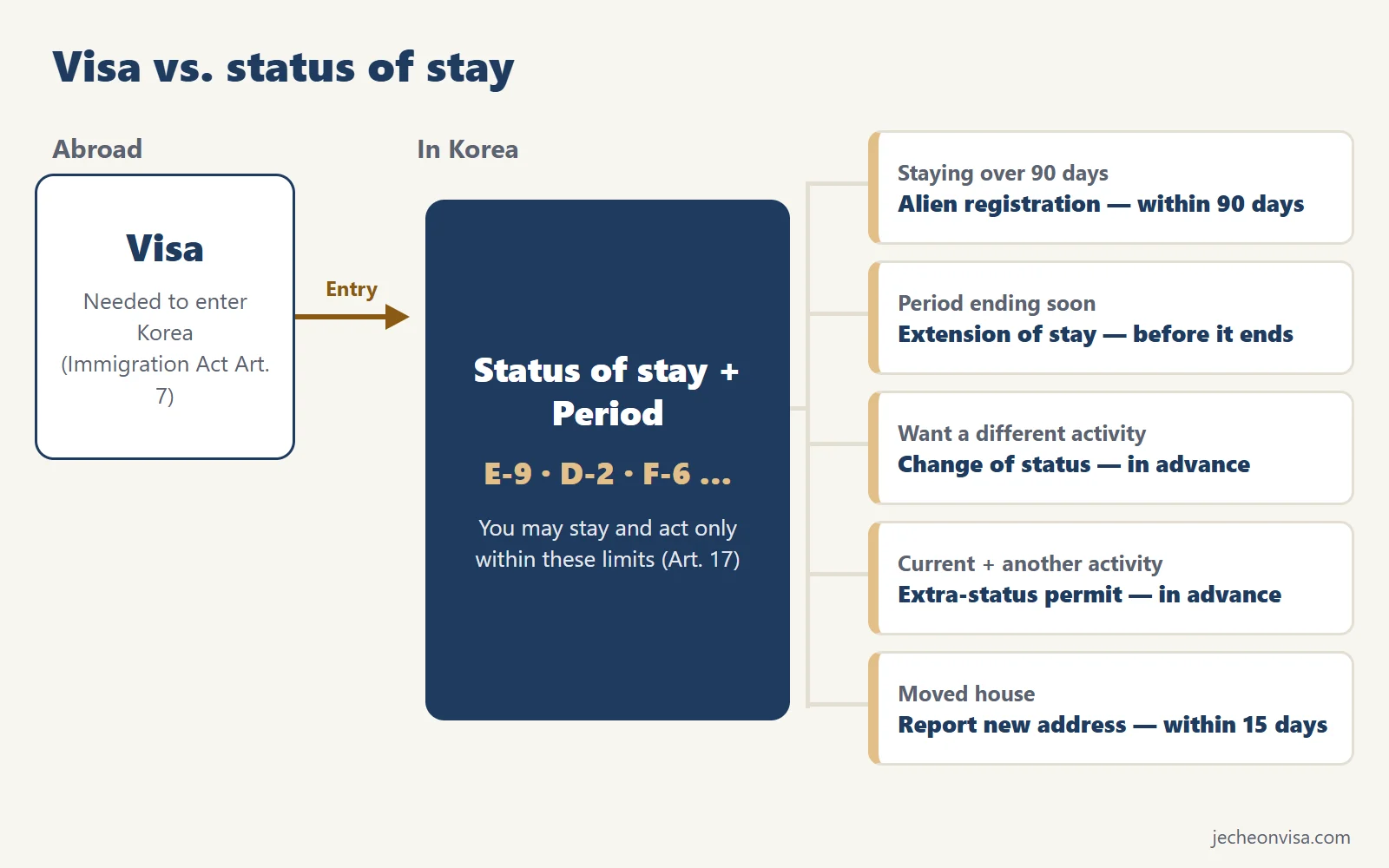
Visa: what you need to enter Korea
- To enter Korea, a foreign national needs a valid passport and a visa (Immigration Act, Article 7).
- Nationals of visa-waiver countries, people with a re-entry permit and some others can enter without a visa.
- A visa is for entry. After you arrive, your status of stay (below) is the standard.
Status of stay: what you may do in Korea
- Every foreign national entering Korea must have a status of stay (Article 10). Codes such as "E-9" and "F-6" are statuses of stay.
- You may stay and act only within your status of stay and period of stay (Article 17).
- There are three broad groups:
- Short-term status: tourism, visits, etc., up to 90 days
- Long-term status: study, training, work, marriage, etc., over 90 days
- Permanent residence: no time limit
Alien registration and period of stay
- If you stay over 90 days, you must register as a foreign resident within 90 days of entry (Article 31). Residents of Jecheon and Danyang are under the Cheongju Immigration Office.
- Long-term statuses come with a period of stay. To stay longer, get an extension of the period of stay before it ends (Article 25).
- After registering, if you move, report your new address within 15 days of moving in (Article 36).
When your activity changes
- To do an activity that belongs to a different status, get a change of status of stay permit in advance (Article 24). Example: a student starting a job after graduation.
- To keep your status and add another activity, get a permit for activities outside your status in advance (Article 20). Example: a student's part-time job.
- Acting without permission can lead to a shortened period of stay, departure orders and other penalties.
Next Monday
[Visa Basics 2] Statuses of stay from A to H at a glance — more than 30 statuses grouped by letter, so you can see where yours belongs.
Consultation
Talk to Jecheon Bareun Visa Administrative Agent Office about the best option for your situation.
- Phone 010-8230-8880 (daily 10:00–20:00)
- Chat on KakaoTalk
- Book a consultation · Ask a question — you can write in English
- What to bring to a visit
Sources
- Immigration Act (출입국관리법) Articles 7, 10, 10-2, 17, 20, 24, 25, 31, 36 — Act No. 21857, in force from 2 Oct 2026
- HiKorea — Ministry of Justice stay information
Based on the law in force in November 2026. Actual requirements must be checked against the law and guidelines at the time of application.