
In No. 1 we saw that inside Korea your status of stay matters more than your visa. This time, let's lay out all the statuses of stay like a map.
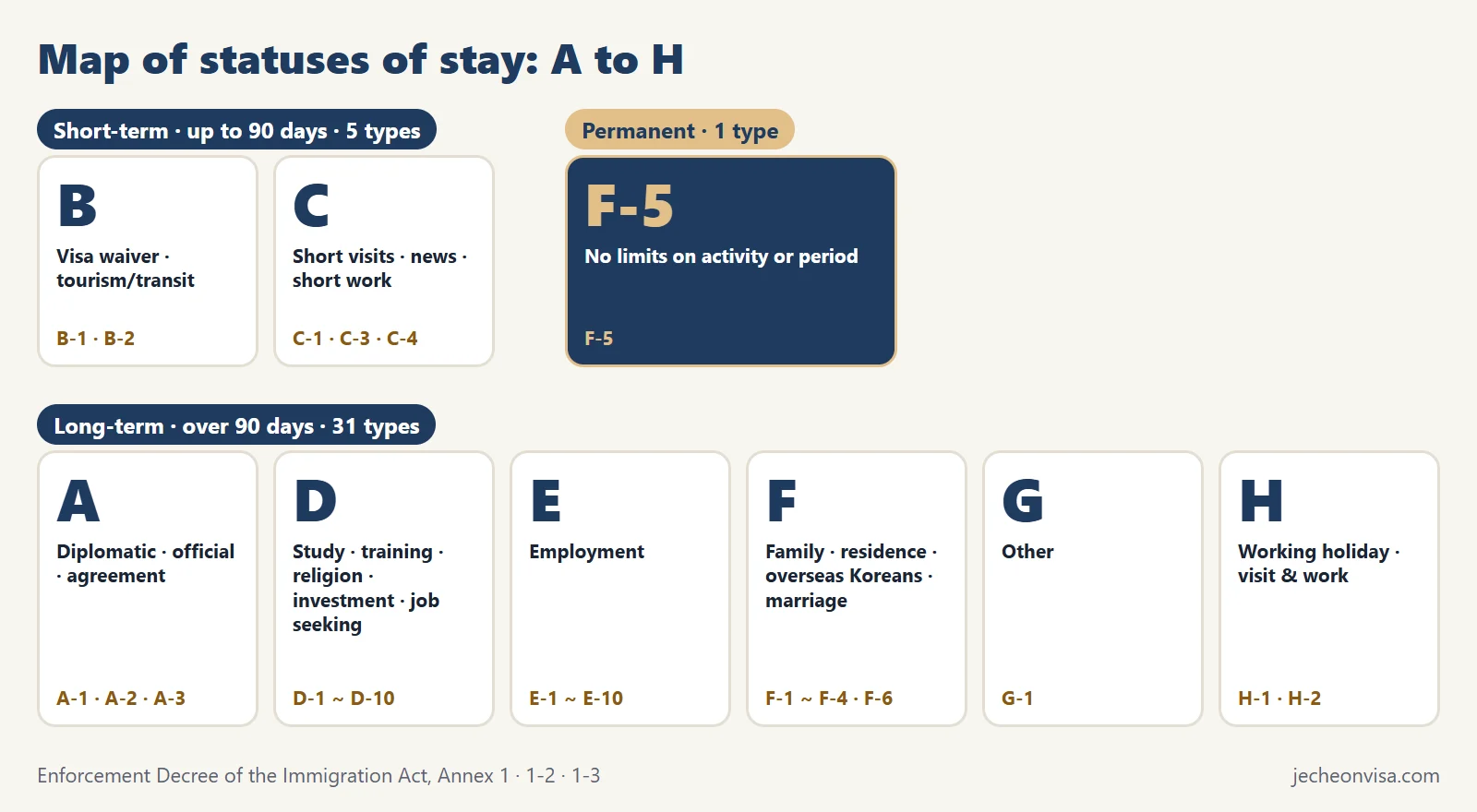
Three groups, 37 types in total
The Enforcement Decree of the Immigration Act sets out statuses of stay in three tables.
- Short-term statuses (Annex 1): up to 90 days, 5 types. B-1 visa waiver, B-2 tourism/transit, C-1 temporary news coverage, C-3 short-term visit, C-4 short-term employment
- Long-term statuses (Annex 1-2): over 90 days, 31 types. A, D, E, F (except permanent residence), G, H
- Permanent residence (Annex 1-3): F-5 only. No limits on activities or period of stay (Immigration Act, Article 10-3).
What each letter means
| Letter | Purpose | Examples |
|---|---|---|
| A | Diplomatic · official · agreement | A-1 diplomat |
| B·C | Short visits | B-1 visa waiver, C-3 short-term visit |
| D | Study · training · news · religion · investment · job seeking | D-2 study, D-4 general training, D-10 job seeking |
| E | Employment | E-7 specially designated activities, E-8 seasonal work, E-9 non-professional employment |
| F | Family · residence · overseas Koreans · permanent residence | F-2 residence, F-4 overseas Korean, F-5 permanent residence, F-6 marriage migrant |
| G | Other (not covered by any other status) | G-1 other |
| H | Working holiday · visit and employment | H-1 working holiday, H-2 visit and employment |
Numbers and letters after the code
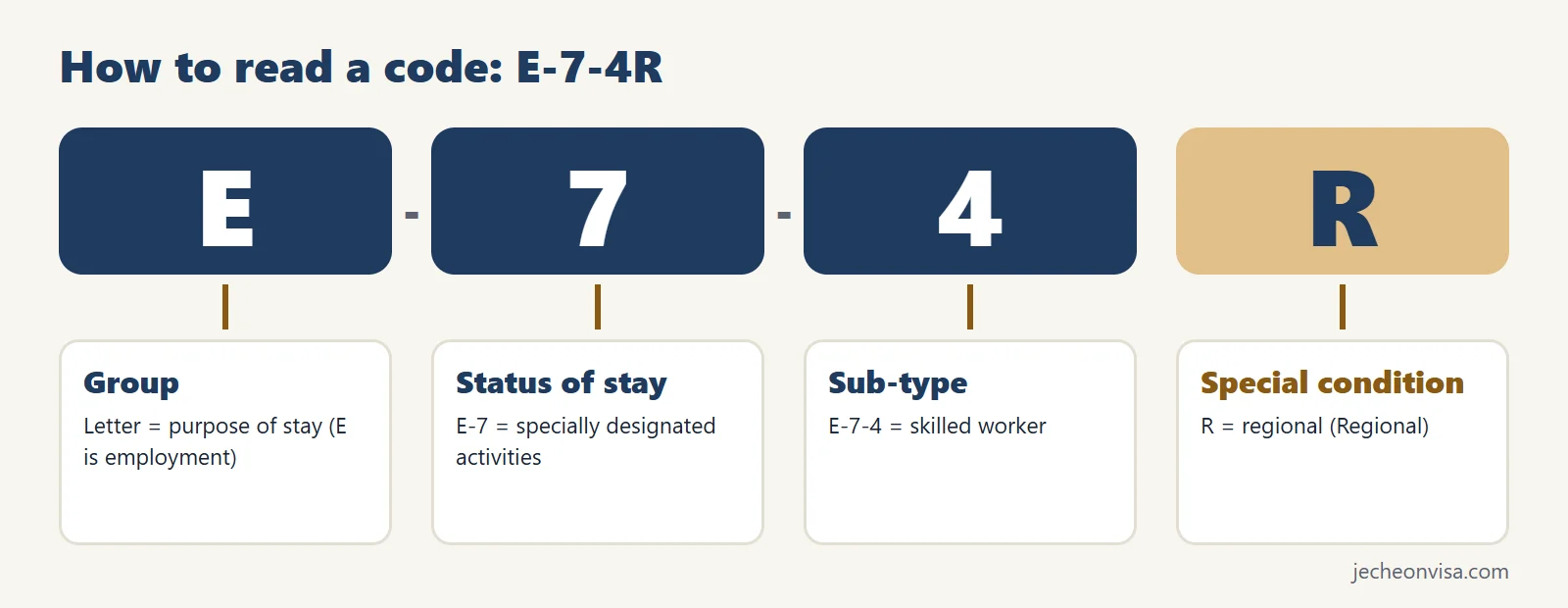
- A number at the end marks a sub-type within the same status. Examples: E-7-4 skilled worker, F-2-7 points-based residence
- A letter at the end marks a version with a special condition. Example: R (Regional) — F-2-R, F-4-R, E-7-4R
Which statuses are common in Jecheon?
At the end of September 2026, among the 4,681 foreign residents of Jecheon, the most common were study (D-2) 1,368, non-professional employment (E-9) 529, overseas Koreans (F-4) 476, dependent family (F-3) 422 and marriage migrants (F-6) 344. We will look at these one by one.
Next Monday
[Visa Basics 3] Skilled workers (E-7-4, E-7-4R) — the main route for E-9 workers to a long-term work status: the points system and Jecheon's regional program.
Consultation
Talk to Jecheon Bareun Visa Administrative Agent Office about the best option for your situation.
- Phone 010-8230-8880 (daily 10:00–20:00)
- Chat on KakaoTalk
- Book a consultation · Ask a question — you can write in English
- What to bring to a visit
Full series contents: [Visa Basics] A new series on visas and status of stay, every Monday
Sources
- Immigration Act (출입국관리법) Articles 10, 10-2, 10-3 — Act No. 21857, in force from 2 Oct 2026
- Enforcement Decree of the Immigration Act (출입국관리법 시행령) Annexes 1, 1-2, 1-3 — in force from 2 Oct 2026
- Ministry of Justice immigration and foreigner policy statistics (registered foreigners and overseas Korean residence reports, as of 30 Sep 2026)
Based on the law and announcements in force in November 2026. Actual requirements must be checked against the law and guidelines at the time of application.